

The Dow crossed 50,000 last week. You probably saw it everywhere.
But here’s the part that didn’t make most headlines: roughly 93% of U.S. stock market wealth is held by the top 20% of households. So when we celebrate a market milestone, we should probably ask—who is it a milestone for?
That’s not a reason to be cynical. It’s a reason to pay closer attention to what’s happening underneath the number. And what’s happening underneath is actually pretty interesting right now.
State of Capital
For the first time in a while, the gains aren’t being carried by a handful of mega-cap tech names. The rally is spreading out.
Smaller companies (tracked by the Russell 2000) are up about 7.6% so far this year. Energy and consumer staples are leading. Even “equal-weight” versions of the S&P 500—where every company counts the same regardless of size—are hitting record highs. The S&P 500 itself is up about 1.4%.
Why does that matter?
When a small group of stocks is doing all the heavy lifting, markets are fragile. One bad earnings report from the wrong company and the whole thing wobbles. But when more sectors and more companies are contributing, the foundation gets sturdier. That’s what we’re seeing now, and it’s a healthier setup for long-term investors than what we’ve had in recent years.
Meanwhile, the 10-year Treasury yield is sitting around 4.21%. That number matters because it touches everything from mortgage rates to how investors value future earnings. It’s been creeping up, reflecting ongoing uncertainty around inflation, government spending, and global capital flows.
On the surface, things look steady. But underneath, money is moving around more deliberately than the headlines suggest
Policy & Economics
You can’t talk about markets right now without talking about the debt picture, so let’s talk about it.
The U.S. is approaching $39 trillion in national debt. Annual tax revenue comes in around $5 trillion. Annual spending is closer to $7 trillion. That’s a $2 trillion gap, every single year, and it keeps compounding.
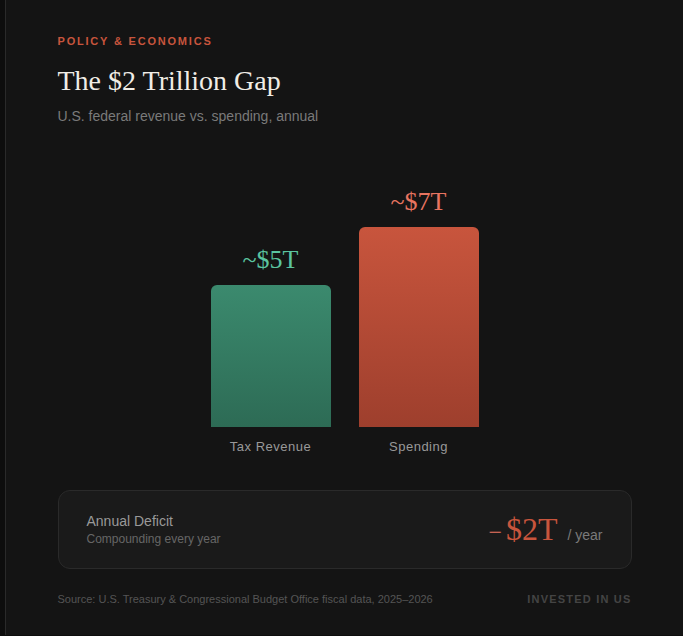
That gap ripples outward. It affects how much the government has to borrow, how bond markets price risk, and where interest rates land over time. Layer in the ongoing political negotiations, funding debates, and global uncertainty and you get a policy environment that feels... unresolved.
One thing worth watching: central banks around the world have been increasing their gold reserves. That’s not a panic move or a short-term trade.
It’s a long-term signal about how major institutions are thinking about currency risk, confidence, and diversification. When the people who manage sovereign wealth start repositioning, it’s worth paying attention to why.
In this environment, interest rates become the anchor point for almost everything else—mortgages, loans, business valuations, and your long-term financial plan.
The Breakdown
Let’s come back to that stat from the top: 93% of stock market wealth, held by 20% of households.
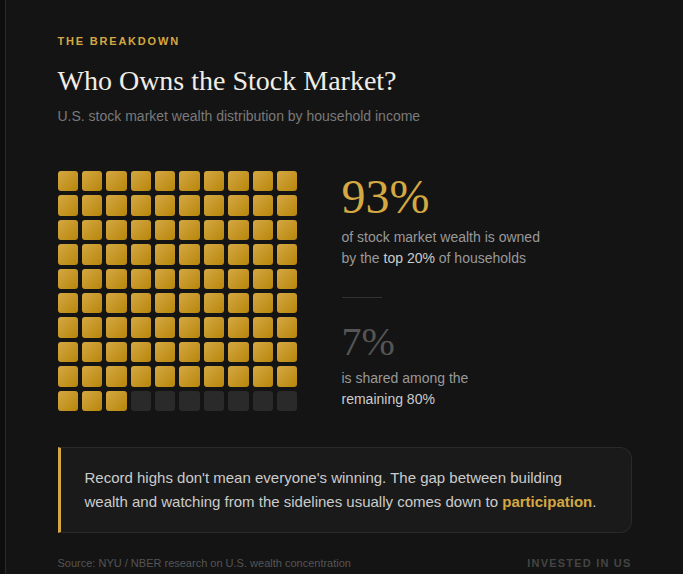
That’s not a reason to avoid the market. It’s actually the opposite. It’s a reason to get in and stay in (with a real plan).
Markets don’t automatically create financial security. Record highs don’t mean everyone’s winning. But the gap between people who build wealth over time and people who don’t usually comes down to a few boring, repeatable things: saving consistently, staying invested through uncomfortable periods, understanding what you actually own and why, and having a plan built for your real life rather than some hypothetical perfect market.
None of that is flashy. Most of it isn’t even interesting to talk about at dinner. But it works.
We focus less on predictions and more on process for exactly this reason. The prediction game is fun until it’s wrong (and it’s wrong a lot). Process is what carries you through the full cycle.
The Conversation
This is a good moment to zoom out.
Yes, the Dow hitting 50,000 is exciting. Yes, volatility will come back and it’ll feel uncomfortable when it does. Both things can be true at the same time.
What’s encouraging right now is the broadening. When more of the market participates, it means the rally has legs beyond just a few names. That’s more durable than what we’ve seen in the last couple of years.
It’s also worth noting that markets outside the U.S.—parts of Asia, parts of Europe—have started outperforming. Opportunity isn’t limited to one country or one index. The investors who do well over full cycles tend to think globally, not just domestically.
Cycles change. Leadership rotates. That’s not something to fear. It’s something to build for.
Closing Thought
The Dow at 50,000 doesn’t eliminate risk. It just changes where the risk is hiding.
And the real question isn’t “what should I do now that the market hit a big number?” It’s “does my plan still work regardless of what number the market is at?”
If the answer is yes, you’re in good shape. If the answer is “I don’t actually have a plan”, that’s what we’re here for.