

The S&P 500 barely moved last week. If you only watched the headlines, you’d think nothing happened.
But something is happening, it’s just not showing up in the index. More and more of the companies driving real growth are choosing to stay private longer, raising billions before everyday investors ever see a ticker symbol. That means the wealth is being created before most people get access to it.
This week, we’re breaking down what that means, why it matters, and what’s actually changing.
State of Capital
The S&P 500 finished the week basically flat, continuing a sideways pattern we’ve been watching for several weeks now. But flat doesn’t mean nothing is going on.
Under the surface, capital is rotating. Energy continues to lead by a wide margin. Materials, industrials, and real estate are all showing strength. Small-cap stocks (tracked by the Russell 2000) are up mid-to-high single digits year to date and are actually outperforming the big indexes.
Meanwhile, the mega-cap tech names that dominated for the last few years? They’re consolidating. Not crashing, just pausing.
This isn’t people pulling money out of the market. It’s money moving around the market, finding new places to go. That’s a meaningful difference, and it tells you something about where investor confidence is actually sitting right now.
Policy & Economics
From Public to Private—and Why It Matters for You
For a long time, the path to building wealth through the stock market was straightforward: companies go public, you buy shares, you participate in the growth.
That path is narrowing.
Over the past two decades, companies have increasingly delayed or skipped going public altogether. They raise billions in private funding rounds, grow for years, and by the time a ticker symbol shows up on your screen, a huge chunk of the value creation has already happened.
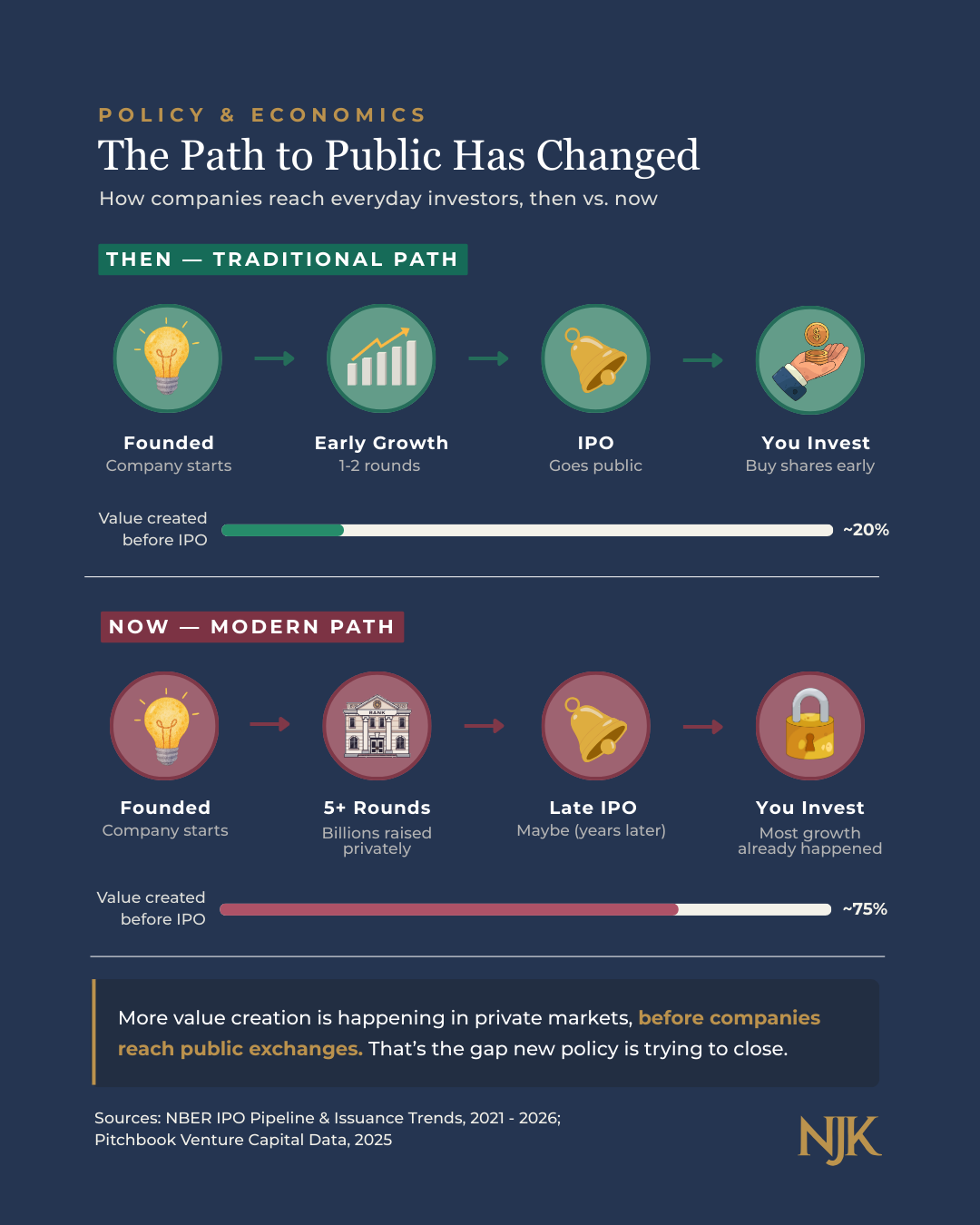
Since 2021, higher interest rates and tighter conditions have slowed IPO activity even further. There was a modest pickup in 2025, but we’re still well below historical norms.
The reasons are real: going public is expensive, scrutiny is intense, and founders increasingly prefer patient capital that lets them build without the pressure of quarterly earnings calls.
Now here’s where it gets interesting from a policy standpoint.
The administration has floated proposals to ease quarterly reporting requirements for some public companies—potentially moving to semi-annual reporting. Less paperwork, sure. But also less transparency for investors. That’s a trade-off worth watching.
More significant: there’s been executive action that would allow retirement plans—your 401(k)—to allocate into private investment strategies like private equity, real estate funds, and hedge funds. Historically, that kind of access was reserved for pensions and big institutional money. Not individual retirement accounts.
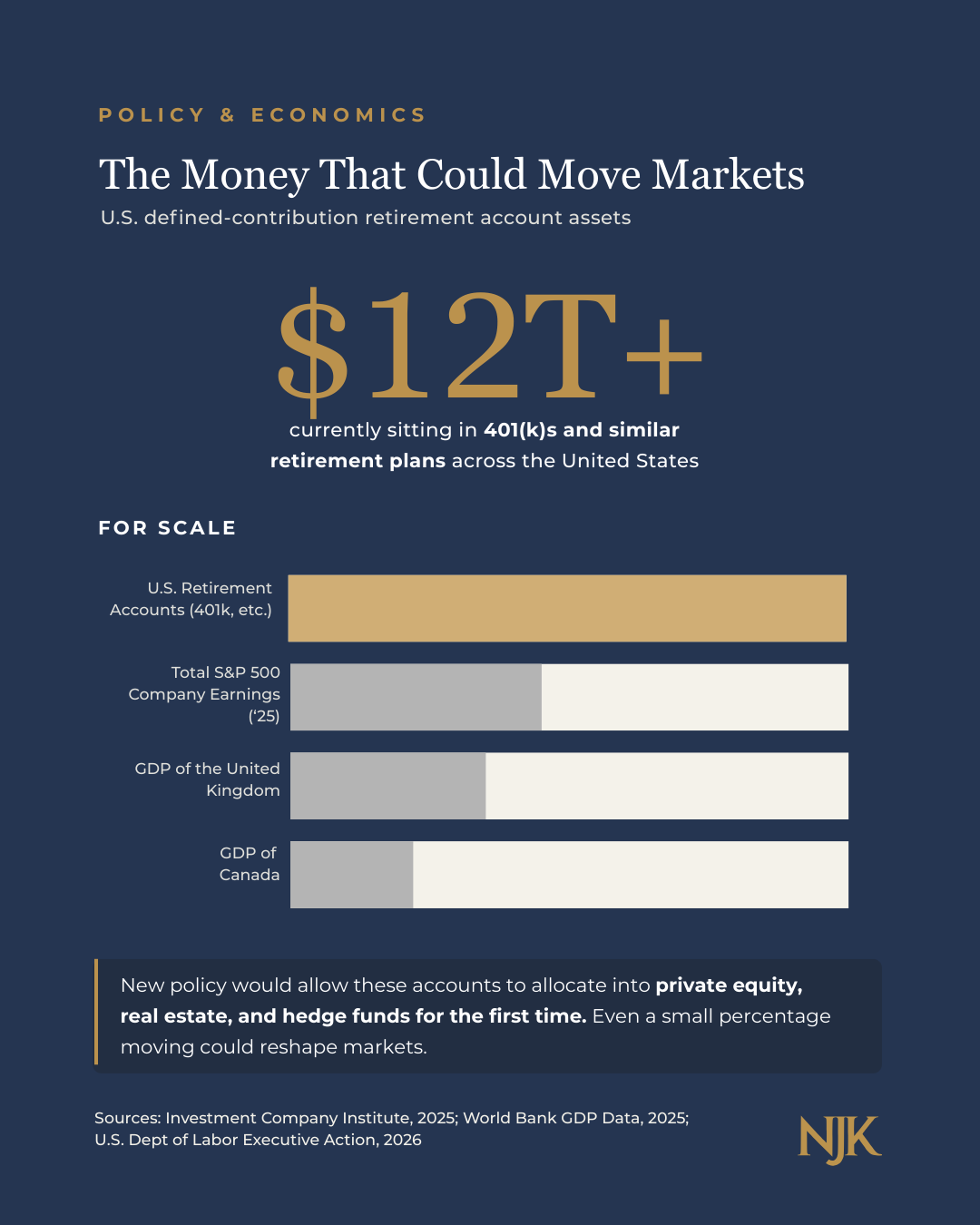
There’s currently more than $12 trillion sitting in defined-contribution retirement accounts in the U.S. Even a small percentage moving into private assets would redirect an enormous amount of capital. If that actually plays out, it could reshape how everyday portfolios are built across the country.
The Breakdown
Access Is Expanding. But Access Alone Isn't Enough.
Let’s be real about what private markets offer—and what they don’t.
The performance numbers are compelling. Over the last 25 years, private equity has generated estimated net annualized returns of roughly 13%, and data from MSCI and Cliffwater shows persistent outperformance versus public benchmarks.
Part of that comes from how private assets are valued (less frequently, which smooths out volatility on paper). But the more durable part comes from what private investors actually do: operational improvements, strategic acquisitions, disciplined exits. It’s hands-on ownership, not passive holding.
That said, private markets carry real risks that don’t show up in the return numbers. Your money is locked up for years. Valuations are opaque, you can’t just check a price on your phone and getting out early usually isn’t an option.
Here’s the other thing worth paying attention to: as more money flows into private markets, it’s concentrating in the biggest asset management firms. That’s great for those firms, but in a downturn, that kind of concentration could amplify problems across the system. A lot of capital in very few hands.
The flipside? Smaller funds in the lower and middle market have historically produced some of the strongest returns: targeting niche industries, overlooked regions, and founder-led businesses at more reasonable prices. Sometimes the less obvious door is the better one.
None of that is flashy. Most of it isn’t even interesting to talk about at dinner, but it works.
We focus less on predictions and more on process for exactly this reason. The prediction game is fun until it’s wrong (and it’s wrong a lot). Process is what carries you through the full cycle.
The Conversation
This is one of those moments where the investing landscape is genuinely changing, not just cycling.
For decades, public markets were the way regular people built long-term wealth. That’s still true, but it’s becoming incomplete. Private markets are growing faster, attracting more capital, and now policy is actively opening the door wider.
That’s a good thing, as long as people walk through that door with the right information. The worst version of this is people chasing returns in asset classes they don’t fully understand because someone told them it’s what the wealthy do. The best version is informed investors adding thoughtful, well-sized private allocations that complement what they already own.
The difference between those two outcomes is education. Which is exactly why we do this.
Closing Thought
The wealthiest investors have always had access to private markets. What’s changing is that access is no longer limited to them.
But access without understanding is just a new way to take on risk you didn’t plan for. The opportunity is real. So is the responsibility to know what you’re getting into before you get into it.
Stay curious. Stay informed. That’s how you make access actually work for you.